von -140 °C bis +260 °CContinuous service temperature resistance
bis +300°CShort-term temperature resistance
0,04-0,10Coefficient of friction against steel
Structure
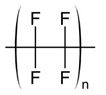
The structure of PTFE resembles that of linear polyethylene (PE), with one important exception: the hydrogen atoms surrounding the carbon backbone have been replaced by fluorine atoms.
PTFE is classified as a thermoplastic, although it also exhibits properties more typical of thermoset plastics; it does not become plastic when heated and does not melt.
PTFE has an unusual combination of excellent chemical, physical, and electrical properties that has not yet been achieved by any other plastic.
Properties
PTFE has a temperature resistance range of -140°C to +260°C. For short periods, it can withstand temperatures up to +300°C. At temperatures above 327°C, PTFE becomes partially crystalline; above 400°C, it releases toxic substances.
PTFE is highly inert and extremely resistant to all bases, alcohols, ketones, gasoline, and oils. An extended overview of the substances to which PTFE is resistant can be found at the end of this page.
PTFE has a very low coefficient of friction. Its static friction is equal to its kinetic friction.
Surface
Due to its extremely low surface tension, there are virtually no materials that permanently adhere to PTFE. PTFE is difficult to wet and can only be bonded after pretreatment.
PTFE is nonflammable and physiologically harmless.
History
Contrary to the claim that PTFE is a byproduct of space travel, it was actually discovered in 1938 by chemist Roy Plunkett while he was experimenting with refrigerants for refrigerators.
In common usage, PTFE is often equated with the name Teflon®, which is a registered trademark of the U.S. corporation E. I. du Pont de Nemours and Company, or DuPont for short. A large proportion of PTFE products are now manufactured and marketed without a specific brand name, as awareness of the term PTFE has increased significantly.
PTFE
PTFE is resistant to, among other substances and influences:
All information refers to virgin (pure) PTFE. PTFE-coated fabrics, PTFE compounds, and PTFE combination products may have different values.
mineral lubricants
aliphatic hydrocarbons
aromatic hydrocarbons
gasoline
weak mineral acids
strong mineral acids
weak organic acids
strong organic acids
oxidizing acids
weak alkalis
strong alkalis
trichloroethylene
perchloroethylene
acetone
alcohols
hot water (hydrolysis resistance)
UV light and weathering
microwaves
Material Consultation
Request a PTFE Application
Contact us if you require PTFE films, coated fabrics, or custom-made parts.